And for what?
You may be gone, but the ideas that you shone light on
will forever shine, turning the quiet of every night
into a loud sound, a ringing in my ears
that blocks the silence I had taken comfort in for so long
You may be gone, but the ideas that you shone light on
will forever shine, turning the quiet of every night
into a loud sound, a ringing in my ears
that blocks the silence I had taken comfort in for so long
Hey bossy pants
Let’s dance
Five rolling aces
Loads of glitter and roses
Five I love you
s
Run of the mill blues
Falling chimneys by the dozen
Fire, fire, fire closer
Shopping at the mall with a cruiser
Bye bye to all of you losers
Sunday, my day, Coca Cola, hooray
Night time, bed time, a song, with rhymes
Here’s an example of a phone call I receive every now and then:
Ring Ring
Hello?
Hi, may I speak to Mansour please?
Speaking.
I’m calling from [organization] regarding [reason for call].
Sure.
Before continuing, I need to confirm your identity. Can you please state your full name, date of birth and address?
At this point, I’m wondering if the company has a picture of a donkey on my file, seeing that I’m being treated like an idiot. Only an idiot would just give out personal details without being 100% sure who the entity on the other end is. And guess what, the only way to be sure that it’s your bank you’re talking to, is to call them yourself. Period.
At one point or another, you may have used Microsoft Outlook to send and receive emails and if you have ever saved an archive file, you know that it is not so easily convertible to other formats. In this post, I’m going to show you a painless and quick way to move all your emails from a PST file to an IMAP server preserving everything, including the date and time the emails were originally sent.
I’m working on a little project to multiboot anything and everything unix in the universe on a single media. This is one of the several utilities that I have written to help with that. It’s a python version of the original decompressor for compressed loopback device (cloop). To extract/decompress the cloop image, you can do:
python cloop-decompress ~/tmp/KNOPPIX ~/tmp/KNOPPIX.raw
Now you can loop mount the raw image as you normally would:
mount -o loop ~/tmp/KNOPPIX.raw /mnt
Setup the serial configuration. Boot the VM. Then run the following to turn the unix socket into a terminal:
socat UNIX-CONNECT:/tmp/com1 PTY,link=/tmp/com1-pty
The above should block for the entire time of the conversation. If it doesn’t, there’s an issue. Fix it!
Then run a terminal program to talk with it:
screen /tmp/com1-pty
As an alternative to using screen, you can use the following in place of socat and screen above:
socat UNIX-CONNECT:/tmp/com1 STDIO,raw,echo=0
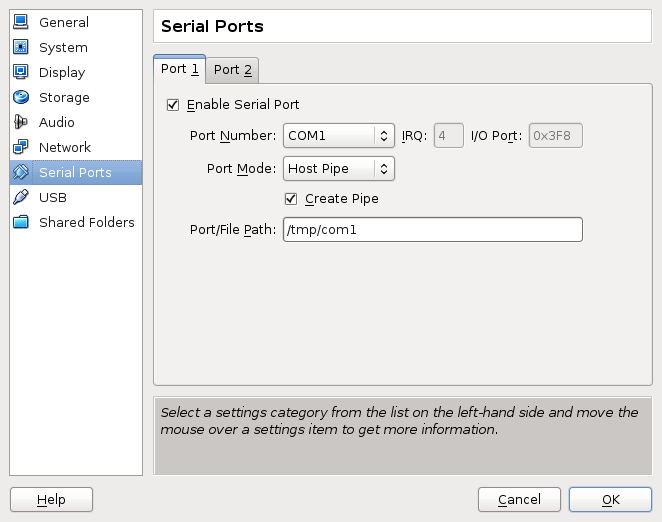
Serial Port Configuration
There are some places even root can’t get to. One such place is a FUSE mounted volume. I found this out when trying to access an sshfs mounted directory as root and got permission denied.
To get around this, do the following (which I learnt by asking about it on serverfault):
user_allow_other to /etc/fuse.conf
-o allow_root option.
Here are a few tricks to programatically find your public IP address:
curl -s http://jsonip.com | sed 's/.*"ip":"\([^"]\+\)".*/\1\n/'
curl -s http://ipinfo.io
A little ghostscript trick to merge multiple PDF files into one:
gs -q -sPAPERSIZE=letter -dNOPAUSE -dBATCH -sDEVICE=pdfwrite \
   -sOutputFile=out.pdf in1.pdf in2.pdf in3.pdf ...